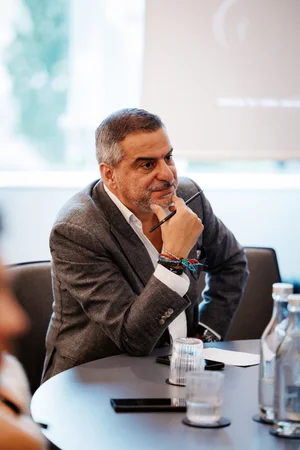
Mental health at work, in three movements: what the individual, the leader and the organisation each owe the person behind the smile.
here was a period in my life when I wore two faces.
At the office, I smiled. I chaired meetings, took decisions, asked the right questions and answered the difficult ones. Nobody would have guessed. Back in my apartment, the smile came off with the jacket, and I was a wreck.
I am telling you this because I know I was not the only one in that building wearing a mask. And I am certain you are not the only one in yours.
What brought me back was not a bonus, a title or a motivational speech. Music and art were my therapy. They gave my feelings somewhere to go when words could not. And I needed someone who would listen, not advise, not fix, just listen.
I will also say something plainly, because it matters more than my story: for many people, the way back must include professional help. Music, art and a good listener are lifelines. They are not a substitute for a doctor or a therapist, and I would never tell anyone they are.
This is what the movement of Silence in my book is really about. Not only the silence a leader uses to listen, but the silence people hide in. Learning to tell the two apart may be the most human skill in leadership.
The numbers behind the smile
The World Health Organization and the International Labour Organization estimate that 12 billion working days are lost every year to depression and anxiety, costing the global economy nearly US$1 trillion. Around 15% of working-age adults live with a mental disorder.
Gallup found that 76% of employees experience burnout at least sometimes, and 28% very often or always. Burned-out employees are 63% more likely to take a sick day and 2.6 times as likely to be looking for another job.
And a new pressure has arrived. A Pew Research Center survey found that 52% of workers are worried about how AI will affect their jobs. Behind that number are very human questions: Will a machine replace me? How will I support my family?
These are not statistics about weak people. They are statistics about strong people carrying too much, for too long, in silence.
What actually triggers it
First, a distinction most organisations get wrong.
Burnout is classified by the World Health Organization as an occupational phenomenon, not a medical condition: the result of chronic workplace stress that has not been successfully managed. It shows up as exhaustion, cynicism or mental distance from the job, and a sense of no longer being effective.
Depression is a medical condition. It can be triggered or worsened by work, but it needs clinical care. People describe it as an abyss: numb to conversation, cut off from the people around them, unable to see a way back.
The two overlap and feed each other. But confusing them leads to the wrong remedy: sending a depressed person on holiday and expecting them to return cured, or sending a burned-out person to a counsellor while leaving untouched the workload that broke them.
Gallup's research names the five factors most strongly linked to burnout:
Unfair treatment at work
Unmanageable workload
Unclear communication from managers
Lack of manager support
Unreasonable time pressure
Notice what they have in common. Every one of them is shaped by how people are led.
Now add AI uncertainty, which rarely appears on any risk register. Then add life outside the office: an illness, a divorce, a debt, an ageing parent, a loss.
Think of an orchestra where every section plays slightly too loud. No single instrument is the problem. Together, they become noise. That is how people break: not from one blow, but from accumulation. They keep playing, keep smiling, until one day they cannot.
Why a bonus will not fix it
Some leaders believe an extra bonus will solve the problem. I understand the instinct. Money is measurable, quick and easy to approve.
But look again at Gallup's list. Workload, fairness, clarity, support, time. Gallup is explicit that burnout depends less on the hours people work than on how they experience the work and how they are managed.
Fair pay matters. Unfair compensation is part of feeling unfairly treated. But a bonus offered instead of respect sends a quiet message: your exhaustion has a price, and we have paid it. Worse, it gives the leader permission to stop looking.
You cannot pay a person out of the abyss.
Movement I: The individual. Break your own silence.
In my book, I write about the silence you keep for yourself: the stillness where judgement is made. But there is another silence, the one we hide in. Stillness restores. Hiding corrodes. Learn the difference.
Name it, to yourself first. Watch for the signals: broken sleep, numbness, irritability, withdrawal, dread on Sunday evening, losing interest in what you once loved. These are not weaknesses. They are information.
Tell one person. Not the whole office. One. A partner, a friend, a sibling, a mentor. You can open with: "I don't need advice. I just need you to listen." You will be surprised how many people can do exactly that.
See a professional. A doctor, a psychologist, a psychiatrist. If medication is part of your treatment, it is no more a failure than a conductor wearing glasses to read the score.
Protect your instrument. Sleep, movement, daylight, food. And find your art. For me it was music and art. For you it might be playing, listening, writing, walking. It will not cure you on its own, but it gives your feelings a place to go.
Separate your worth from your job title. If AI is keeping you awake, write down what you do that requires judgement, relationships, taste and trust. Ask your manager directly what AI will change in your role. Learn one new skill. Fear shrinks when it meets information.
Shrink the horizon. When the whole year feels impossible, conduct one bar at a time. Today. This week.
Know your red line. If you have thoughts of not wanting to be here, or of harming yourself, treat it as an emergency and reach out now, to a crisis line, a doctor or emergency services. Helplines are listed at the end of this article. This is not a moment to be strong alone.
Movement II: The leader. The silence you leave for others.
In The Maestro CEO I wrote that a leader who fills every silence trains an organisation to wait for them. When it comes to mental health, the leader who fills every silence never hears the person who is struggling.
I also wrote that when leaders stop listening, they stop seeing people, and employees become functions. That is how people become numbers. Not through cruelty, usually, but through noise.
Listen for change, not state. The quiet one who stops speaking in meetings. The reliable one who is suddenly late. The high performer replying to emails at 2am. The colleague whose humour has gone. You are not diagnosing. You are noticing.
Ask twice. "How are you?" "Fine." "How are you, really?" Then hold the pause. Count to five in your head. The true answer usually arrives in the silence after the second question.
Listen without fixing. Your instinct as a leader is to solve. Resist it. Do not advise, compare or minimise. Never say "everyone is stressed." Say: "Thank you for telling me. What would help right now?"
Then fix what is yours to fix: the work. Listening comes first, but it cannot be the only thing. Move a deadline. Remove a project. Clarify a role. Correct an unfairness. Gallup found that employees who strongly agree they feel supported by their manager are about 70% less likely to experience burnout regularly. Care becomes real when it changes the workload.
Know your limits. You are not a therapist. Point to professional help, offer to help make the first call, and keep what you hear confidential.
Tell the truth about AI. Do not promise that nobody will be affected if you do not know. Say what you know, what you do not, when you will know more, and how you will help people adapt. Uncertainty with a date is bearable. Uncertainty with silence is not.
Model it. Take your leave. Switch off. If you can, say that you have struggled too. When a leader admits it, permission travels down the hierarchy faster than any policy.
Plan the return with them, not for them. After a long leave: a phased return, a regular check-in, no surprise backlog, and no change in how the person is seen.
Movement III: The organisation. A culture where silence is not fear.
I have walked into rooms where the silence told me more than any report could. The energy was flat, not because people lacked talent, but because they lacked psychological safety.
Every organisation has two kinds of silence: the healthy pause, and the fearful hush. Culture decides which one fills the room.
Treat mental health as a design issue, not a perk. Yoga sessions and fruit bowls on top of impossible workloads are decoration. Look first at staffing, workload, deadlines and how work is organised.
Train your managers. The WHO's guidelines on mental health at work recommend, for the first time, training managers to prevent stressful working environments and to respond to workers in distress. Most managers were promoted for technical skill. Nobody taught them this.
Measure the drivers, not just the mood. Engagement scores can hide a lot. Track fairness, workload, role clarity and manager support. Watch sick days, overtime and attrition by team, as early warnings, never as surveillance.
Make help easy, confidential and genuinely covered. Check that your health insurance covers mental health meaningfully. If your employee assistance programme sits unused, do not assume people are fine. Ask whether they trust it.
Make it safe to say. Stigma is the reason people fake the smile. Senior leaders who share their own stories, real confidentiality, and no career penalty for sick leave do more than any poster campaign.
Run AI adoption as a people programme. Research from JFF found that 56% of workers say their employer has not consulted them on how AI tools are used in their work. Consult before you deploy. Invest in reskilling. Publish timelines. ADP Research reports that workers who feel their employer is investing in their skills are far more likely to feel their jobs are secure.
Reward healthy performance. Promote the managers whose teams deliver and stay well, not the ones who hit the number by burning the people. What you reward is what you will get.
Protect the rests. Meeting-free time. Clear norms on after-hours messages. Holidays where nobody is expected to answer email. In music, the rests are written into the score. In organisations, they have to be written into the culture.
Here is a simple test of any culture. Could someone in your organisation tell their manager "I'm not okay" on Monday, and still be considered for promotion on Friday? If the honest answer is no, every wellbeing initiative you run is playing over a wrong note.
FAQ
What triggers burnout at work?
Gallup's research points to five main factors: unfair treatment, unmanageable workload, unclear communication from managers, lack of manager support, and unreasonable time pressure. Personal pressures and uncertainty, including fears about AI, add to the load.
Is burnout the same as depression?
No. The WHO classifies burnout as an occupational phenomenon caused by chronic, unmanaged workplace stress. Depression is a medical condition that needs clinical care. They can overlap, which is why anyone who feels persistently low should speak to a professional.
Does giving employees a bonus reduce burnout?
Not on its own. Fair pay matters, but burnout is driven mainly by workload, fairness, clarity and manager support. A bonus that replaces those changes treats the symptom and leaves the cause.
How can a manager support an employee who is struggling?
Notice changes in behaviour, ask more than once, listen without trying to fix, then change what is within your control, such as workload and deadlines. Point the person to professional help and keep the conversation confidential.
How can organisations reduce AI-related anxiety at work?
Consult employees before deploying AI tools, communicate honestly about what will change and when, and invest visibly in reskilling. Uncertainty without information is what turns change into fear.
Not every silence is emptiness
In a musical score, the rest is not a gap. It is part of the music, written as deliberately as any note.
Leadership has rests too. Some of them heal: the pause in which you listen, the stillness in which you recover. Some of them harm: the faked smile, the question never asked, the fear nobody names.
What helped me most was never advice. It was being listened to, and a silence offered by someone else that made room for mine to end.
If you are reading this from behind a smile today: tell one person this week.
If you lead people: ask twice, and hold the pause.
If you shape culture: make the second answer safe to give.
To see how well you use silence as a leader, take the Silence Score. For a new movement every week, subscribe to Conducting Leadership.
If you are struggling right now
In the UAE, the National Mental Support Line is free on 800 HOPE (800 4673), by phone or WhatsApp, in Arabic and English. In Abu Dhabi, 800 SAKINA (800 725462) offers 24/7 psychological support. In Dubai, call Itma'en on 800 506. Elsewhere, find a free, confidential helpline in your country at findahelpline.com. If you are in immediate danger, call your local emergency number (999 in the UAE).
This article is leadership commentary drawn from personal experience. It is not medical advice. If you are concerned about your mental health, please speak to a qualified professional.