Leading the Multicultural Orchestra: What UAE Executives Must Learn from the Conductor's Podium
No country on earth presents the leadership challenge quite like the UAE. And no metaphor illuminates how to meet it quite like the one standing at the front of an orchestra.
I have led teams across Europe, North Africa and the Middle East. Each environment taught me something different about leadership, about what works, what fails, and what simply does not translate. But none of those environments tested my assumptions more completely than the UAE.
The numbers alone tell you something is different here. More than 190 nationalities live and work within these borders. In Abu Dhabi and Dubai, the expatriate population accounts for roughly 88 per cent of the workforce. On any given day, a senior executive in a mid-sized company might lead a team that includes an Indian finance director, an Egyptian operations head, a British marketing strategist, a Filipino customer service manager, and a half-dozen other nationalities spread across functions and floors.
This is not diversity as a policy aspiration. It is diversity as an operational reality.
And it is also, if you know how to conduct it, one of the most extraordinary leadership opportunities in the modern business world.
The Problem Most UAE Executives Don't Admit
I once inherited an organisation here that prided itself on its diversity. Multiple nationalities, multiple disciplines, deep experience alongside fresh perspectives. On paper, it was extraordinary. The talent was genuinely exceptional.
And yet performance was inconsistent. Morale was fragile. Decision-making was painfully slow.
The issue wasn't the people. It wasn't the market. It wasn't the strategy. The issue was orchestration.
No one had taught these people how to listen to each other. Different cultures, communication styles, and professional backgrounds had introduced richness, but they had also introduced friction and misunderstanding. What looked like collaboration on an organisational chart was, in practice, a collection of talented musicians all playing different pieces simultaneously in the same room.
A diverse organisation without a shared vision is like an orchestra without sheet music. Everyone may be gifted. But everyone improvises in isolation.
The moment I understood that , truly understood it, not as a concept but as a diagnosis, my entire approach to leading in the UAE changed.
What the Conductor Knows That Most Executives Don't
Stand at the back of a concert hall during a rehearsal. Watch the conductor work.
The musicians come from everywhere. In a major international orchestra, you might find players trained in Moscow, Berlin, Seoul, Buenos Aires, and New York; all sitting within ten metres of each other, all holding instruments with entirely different characters and registers, all with deeply personal interpretations of the music they have spent their lives studying.
The conductor does not ask them to become the same. Does not flatten their individual artistry or suppress their cultural instincts. Does not pretend that a cellist from Vienna and a percussionist from Tokyo approach music identically.
The conductor gives them a shared score. A common rhythm. A unified interpretation.
And then, this is the part most people miss, the conductor listens. Listens to what the ensemble is actually producing, not just what the conductor imagined it would produce. Adjusts. Shapes. Balances the trumpets against the strings. Brings the quieter voices forward. Signals when one section is overwhelming another.
The UAE executive faces the exact same challenge at work every morning.
The Score That Everyone Can Read
During a period of rapid expansion across the Middle East, I made a mistake that is common among executives operating at speed: I assumed that clarity of direction was sufficient. I communicated the strategy. I set the targets. I established the rhythm of meetings and reporting.
What I did not do was ensure that each person on the team could genuinely read the same score.
One evening, a colleague approached me privately. "The team is following you," she said, "but they are struggling to keep up."
That sentence hit me like an unexpected chord from a pianist who suddenly shifts key. It was both dissonant and necessary.
I had been conducting at a tempo that made sense to me, someone shaped by European corporate environments, conditioned to move fast, comfortable with ambiguity and rapid iteration. But several members of my team had come from professional cultures where hierarchy means you do not question pace, where loyalty means you keep up regardless of the personal cost, and where admitting difficulty to a senior leader feels professionally dangerous.
They were following me. They were not performing with me.
There is a profound difference.
I slowed down just enough to bring the team back into coherence. Not back into comfort, into coherence. The result was not lost momentum. It was regained alignment. And alignment, in a multicultural environment, is worth more than speed.
Trust Across Cultural Registers
The UAE has taught me more about trust than any leadership programme I have ever attended.
I have worked in Arab markets for over a decade, and they became some of my most important teachers. In these environments, I learned that without trust, you have nothing. And trust here is not granted quickly. It is earned slowly, deliberately, through consistency of behaviour rather than brilliance of presentation.
I learned that arriving with answers before earning the right to ask questions closes doors quietly, without anyone telling you they have closed.
I learned that listening, truly listening, not the performative listening of someone waiting to respond, creates openings that no contract ever could.
In boardrooms shaped by Western business culture, trust is often a byproduct of performance. Deliver results, earn trust. But in much of the Middle East, and in many of the Asian professional cultures that populate UAE workforces, the sequence is reversed. Trust is a prerequisite for performance. You must earn the relationship before you earn the result.
The conductor who steps onto the podium without first earning the orchestra's respect will find that technically perfect gesture-work produces technically adequate music. The conductor who has earned the ensemble's trust produces something else entirely: music that the musicians are personally invested in, because the relationship between podium and pit has made it feel like theirs.
What Diversity Actually Requires of You
A symphony orchestra with only violins is not an orchestra. It is a section. Beautiful, perhaps, within its register. But it cannot produce the full range of human emotion that music demands. The reason an orchestra is an orchestra is precisely because it contains instruments that sound completely different from each other, that approach the score from entirely different registers, and whose combination produces something no individual section could create alone.
The UAE executive who has built a genuinely multicultural leadership team, and has learned how to conduct it, holds a competitive advantage that cannot be replicated by any business with a homogeneous team.
This is not a moral argument. It is a commercial one.
Teams with genuinely diverse thinking, different cultural contexts, different professional backgrounds, different life experiences, consistently outperform homogeneous ones on complex problems. Not because difference is always comfortable, but because difference forces the examination of assumptions.
When everyone in the room has been trained to see a problem the same way, no one notices the blind spots. The echo chamber moves quickly to confident conclusions that turn out to be wrong.
The friction of genuine intellectual diversity, where people see the same challenge from different angles and challenge each other's conclusions with genuine curiosity is the most productive environment I have ever worked in. It is also the hardest to build. Because homogeneity is comfortable. Similar people tend to like each other, communicate easily, and move quickly.
Diversity requires more from the leader.
Three Principles for the UAE Executive
After more than a decade of leading multicultural teams in the region, I have distilled what conducting this particular orchestra requires into three principles.
Give people a score they can all read. Not a strategy document. Not a vision slide. A score: a clear, shared articulation of what we are building, why it matters, what success looks like, and how each person's contribution connects to it. The score must be translated not linguistically, but conceptually for every cultural context on the team. What "urgency" means in a European professional culture is not what it means in a Gulf Arab context. The score remains constant. The translation must be deliberate.
Listen for what is not being said. In multicultural environments, silence is information. A team member who does not challenge a decision in a meeting is not necessarily agreeing, they may come from a professional culture where public disagreement with a senior leader is unacceptable. The conductor who only hears the music being played, and never listens for what is being held back, will consistently misread the room. Create channels for honest input that do not require cultural courage to access.
Earn trust before you demand performance. This is the most counterintuitive principle for executives shaped by results-driven Western corporate cultures. In the UAE, where your team likely includes significant proportions of professionals from cultures where the relationship precedes the transaction, attempting to extract performance before you have built the relational foundation will produce compliance without commitment. The orchestra can play the notes. Only the orchestra that trusts the conductor plays the music.
The UAE's Leadership Opportunity
The UAE itself is a remarkable study in what happens when this kind of multicultural orchestration is done at a national level.
This country has built a future by blending rigorous structure with remarkable improvisation. National visions, legislative frameworks, and free-zone architectures provide the score. Bold pivots into space technology, artificial intelligence, financial services, and healthcare delivery provide the improvisation. Leaders at every level of the UAE's development have mastered the art of holding long-term direction and short-term adaptation simultaneously the defining skill of the great conductor.
For the executive leading in Abu Dhabi or Dubai today, this is the environment you are operating in. A country that has proved, at scale, that diversity of origin does not prevent unity of purpose.
What it requires is a conductor.
Not someone who silences the differences. Not someone who pretends the cultural distances do not exist. Someone who stands at the front of a genuinely extraordinary ensemble, raises the baton, and trusts that what these musicians can create together precisely because they are different, is something none of them could have created alone.
The music is already in the room.
The question is whether you know how to draw it out.
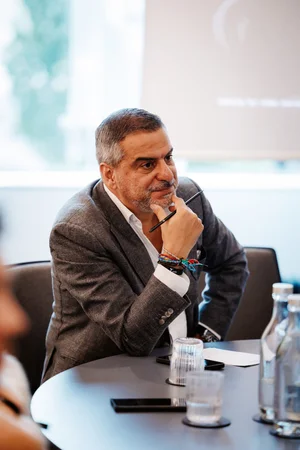
José Micallef is the author of The Maestro CEO: Leadership as an Art Form, launching September 2026. He is CEO for the Middle East at Yolo Group, based in Abu Dhabi, with over thirty years of executive leadership experience across Europe, North Africa, Asia, and the Middle East.
Subscribe to Conducting Leadership - weekly leadership insights, every Tuesday.
Leadership as an art form - the full series
Leading by listening: what conductors hear that managers miss
When to step back: empowering your stars without losing the ensemble
Pacing change: how maestros manage tempo, dynamics and crisis
Leading the multicultural orchestra: UAE executives and the conductor's podium